Drive nineteen miles west on M-21 and you land in downtown Grand Rapids. Stop about halfway and you're standing in Ada. That single fact, more than square footage or granite counters, explains why a home in Ada can cost nearly $250,000 more than a nearly identical one nine miles down the road in Lowell.
As of April 2026, the typical home value in Ada sat at $654,671, up 4.6% year over year. As of July 2026, Lowell's typical value was $413,212, up 4.9% over the same stretch. That's roughly a 58% gap between two towns that share a school-adjacent commuter identity, a river, and a stretch of the same highway. Most buyers assume the difference is about house quality. It isn't, not primarily. It's about geography that happened to get developed on purpose.
The Gap on Paper
Start with what a dollar buys inside Ada itself, because the town isn't one price point, it's a stack of them. Condos and attached homes generally run $300,000 to $475,000, the lower-maintenance entry point into the district. Established three-bedroom homes in the 1,800 to 2,600 square foot range typically land between $450,000 and $625,000. Move up to a four-bedroom, 2,600 to 3,800 square foot home and the range climbs to $625,000 to $900,000. New construction and custom builds commonly start at $850,000 and run past $1.5 million. Riverfront estates on the Thornapple frequently clear $1.2 million, where frontage drives the price as much as the structure does.
Price per square foot follows the same climb: a baseline around $215 for typical inventory, climbing past $285 and into the $600s for riverfront and custom product. Lowell has nothing that competes at the top of that range, and that's the point. The gap between the two towns isn't a uniform markup on every house. It's concentrated in a specific slice of Ada's inventory, and thin everywhere else.
The Twelve Minutes You're Actually Paying For
Here's the mechanism most comparison shoppers miss. Ada isn't just closer to Grand Rapids than Lowell is. It's the midpoint between the two.
Mapping data puts the drive from Lowell to Ada at about 12 to 13 minutes, and from Ada into Grand Rapids at another 12 to 14. Drive straight from Lowell to Grand Rapids without stopping in Ada and the trip takes roughly 27 minutes. In other words, a homeowner in Ada gets a Lowell-length commute in both directions: a short hop to the small-town amenities of Lowell one way, a short hop to downtown Grand Rapids and Amway's headquarters the other way. A homeowner in Lowell gets the small town on their doorstep and a much longer haul to the city.
That symmetry is worth something real to a buyer whose household splits time between a Grand Rapids office and weekend errands further out, and it's baked into the price in a way no listing description spells out. You're not paying for a shorter commute. You're paying for a commute that's short in both directions at once.
A Village That Was Built, Not Grown
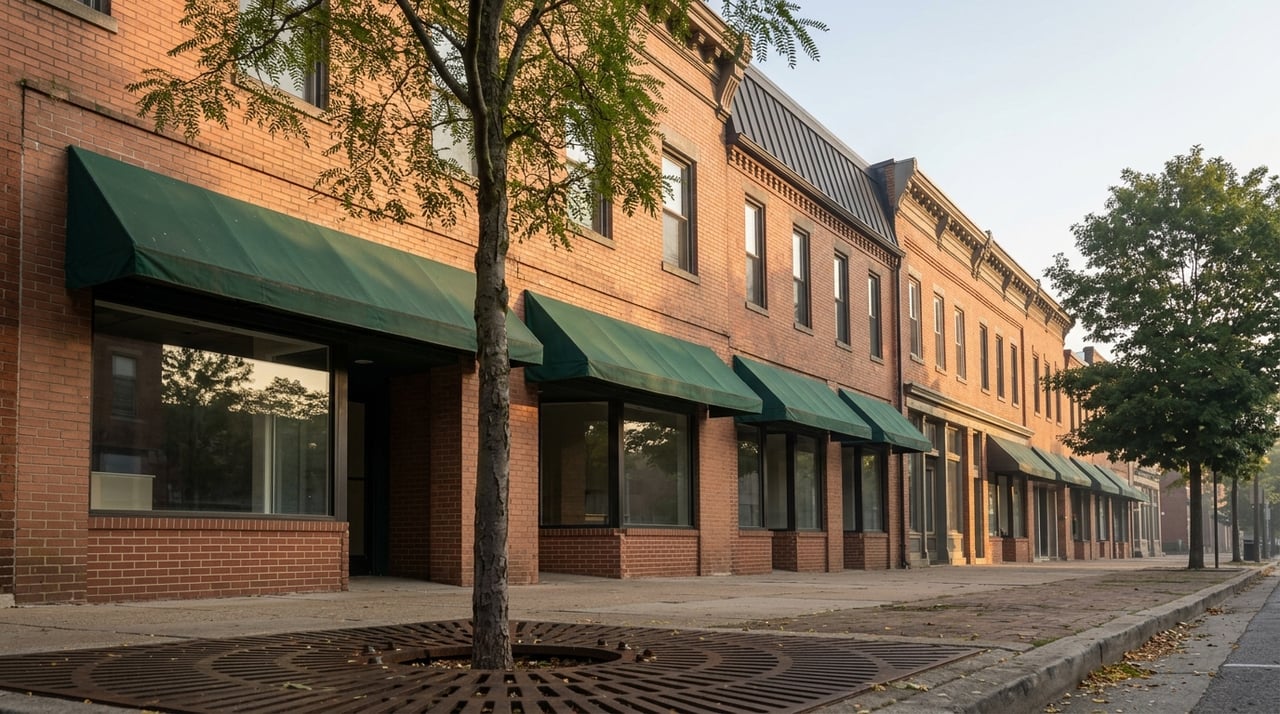
The second mechanism is less about geography and more about a deliberate decade of public and private coordination. Ada's downtown didn't organically fill in the way most small Michigan towns did. Township leaders drew up an initial concept plan in 2006, revisited it with more detail in 2013, and broke ground on the redevelopment in earnest starting in 2015. That effort has since remade the village core into something closer to a walkable destination than a pass-through on the way to somewhere else.
The township adopted form-based code zoning, which lets it regulate details like window sizing and building design so new construction reads as an extension of the historic core rather than a break from it. You can see the layering in what got built alongside what stayed:
- JH Realty now occupies a building constructed in 1854.
- Godwin's Ada Village Hardware dates to 1915 and still operates in the district.
- The Ada Hotel opened in 2024, anchoring the west end of downtown with retail and office space built alongside it.
- Legacy Park and the Van Andel Pavilion, a popular events space along the Thornapple, opened a few years before that.
- Village East, a 92-unit apartment complex across four buildings, opened in 2023.
- An 88-unit riverfront housing development and a smaller six-unit project at Thornapple River Drive and Headley Street were both part of the pipeline the township approved as the buildout continued.
Before the redevelopment, businesses along the river faced their loading docks and dumpsters toward the water. Township leadership pushed to flip that orientation, turning the riverfront into the district's front door instead of its back one. That's not a subtle distinction. It's the difference between a town that happens to sit on a river and one that's built its entire commercial identity around it.
Layer onto that Amway's global headquarters, based in Ada since 1959 and one of the largest privately held companies in the country, and you have a steady, high-wage employment base that keeps demand from softening even when the broader state market cools.
Where the Premium Concentrates, and Where It Doesn't
None of this means every house in Ada carries the same markup. The township's housing stock is a patchwork of subdivisions built across five decades, and the premium isn't evenly spread across them.
| Segment | Typical Range | What's Driving the Price |
|---|---|---|
| Condos and attached homes | $300,000–$475,000 | Lower-maintenance entry point, closest to raw Lowell pricing |
| Established single-family (3 bed) | $450,000–$625,000 | Mature lots in subdivisions like Ada Woods, Hunters Run, and Cranbrook Estates |
| Move-up single-family (4 bed) | $625,000–$900,000 | Larger footprints in Bridlewood Estates, Deer Ridge Estates, and similar |
| New construction and custom | $850,000–$1.5M+ | Newer builds including the Oxbow neighborhood along the Thornapple |
| Riverfront estates | $1.2M+ | Frontage itself, not just the structure on it |
The oldest, most established subdivisions, the ones that make up the bulk of Ada's inventory, sit closest to Lowell's price range once you strip out riverfront lots. The real separation shows up at the top: the Thornapple corridor and the newer builds along it. If you're cross-shopping Ada against Lowell because the median headline number scared you off, it's worth asking an agent to isolate comparable inventory rather than comparing town-wide averages. The gap on a like-for-like established three-bedroom is smaller than the ZHVI numbers suggest. The gap on a riverfront custom build is larger.
It also matters that the new supply coming into Ada isn't aimed at that established single-family tier. Village East added 92 units as apartments, and the 88-unit riverfront project and the smaller Thornapple River Drive development were both structured as multi-unit housing rather than standalone single-family lots. That means the scarcity propping up prices in Ada Woods, Hunters Run, and the other established subdivisions isn't likely to ease just because construction cranes are visible from the village center. The new units compete with rentals and attached product, not with the three- and four-bedroom homes driving the bulk of the town's demand.
What This Means If You're Comparing the Two Towns
If your priority is proximity to a specific small-town identity and you don't need the symmetric commute, Lowell's price point buys a comparable house for meaningfully less money. If your household needs short trips in both directions, toward Grand Rapids for work and toward a walkable downtown for daily life, the Ada premium is functioning as a toll on that symmetry, not a markup on granite and square footage. And if you're eyeing Ada specifically for the riverfront or new construction segment, understand that segment is the one carrying almost all of the town-wide premium. The established subdivisions in between are closer to Lowell pricing than the headline numbers imply.
A Couple of Questions Worth Asking Before You Commit
Does Lowell's longer commute actually matter day to day? It depends on how often the drive happens and in which direction. A household making the Lowell to Grand Rapids trip five days a week absorbs roughly an extra 25 to 30 minutes round trip compared to commuting from Ada. A household that rarely leaves Lowell for work may never notice the difference at all.
Will the new construction in Ada eventually pull prices down? Based on what's currently approved, unlikely in the near term. The units in the pipeline are multi-family and rental-oriented, which addresses a different part of demand than the single-family inventory driving the town's median price.
If you're trying to figure out which side of that nineteen-mile stretch actually fits your budget and your commute, that's exactly the kind of comparison worth walking through with someone who tracks both markets closely. West Michigan Homes and Land works across Ada, Lowell, and the rest of the Grand Rapids corridor, and can help you pull comparable listings in both towns side by side. Explore West Michigan Listings to see what's currently on the market in either direction.